SOAN 232: Medicine and Culture, Spring 2023
Linfield College, Department of Sociology and Anthropology
Tuesday / Thursday
Section 1: 2:45-4:20
Section 2: 4:30-6:05
Walker Hall, Room 203
Instructor: Wynn Strange
Pronouns: they/them/theirs
Salutations: Instructor, Professor, Wynn
Office: Walker 218
E-mail: wstrange@linfield.edu
Office Hours: via Zoom by appointment
Course Description
This is an introductory course that will take a sociological approach to explore social contributions to understanding illness, pathology, wellness, and medicine. We will explore the history of healthcare and comparative case studies to understand how non-Western societies perceive and treat healthcare needs and how knowledge of non-Western practices can be used to critique and inform the management of healthcare problems around the world.
Course Goals
Identify and understand core qualities of Western philosophical thought that had influenced dominant approaches to health, medicine, and illness in a globalized context.
Explore the ways health, medicine, and illness are understood by their history and geography. History encompasses understanding the social aspects of health, illness, and medicine; how shared culture and history of people shapes their perceptions, experiences, and interactions with institutions of health and their experiences with wellness and illness.
Develop and improve on your learning skills. Education and work after your degree requires a level of feeling of self-efficacy, that is the feeling that you possess the skills or have the capacity to possess the skills to accomplish a task. The assignments in this course are intended to develop your ability to access, recognize, organize, and analyze knowledge, and to effectively communicate the knowledge you have produced through the synthesis and analysis of your work.
Linfield Curriculum
This course satisfies the Individuals, Systems and Societies (IS) or Global Pluralisms (GP) portions of the Linfield Curriculum. In order to earn an IS or GP for this course, students who entered Linfield Fall 2010 or later must submit exemplar work and supporting descriptions by the last day of finals week, as discussed in the Linfield College Course Catalog. Which of the GP or IS goals your exemplars illustrate will depend on which articles/books you choose to read for your papers. Choose with these goals in mind.
IS Learning Goals: Understand individual, systemic, and/or social processes. Examination of interconnections among cultural, political, social, economic and other processes using cultural anthropology’s holistic, synthetic perspective.
Analyze individuals, systems, and/or societies through multiple frames of reference. Anthropology’s macro-micro, stereoscopic approach to seeing how large-scale processes play out on the ground in the everyday lives of ordinary people and their understandings of their bodies is central to this course.
Think critically about the ways that society affects individual behavior and/or individual behavior affects society. Individual/societal relations examined thoroughly through written and oral analysis of ethnographic material.
GP Learning Goals: Develop an understanding of a people outside the US from a disciplinary or interdisciplinary perspective. Anthropology is at its core global and cross-cultural in perspective. This course brings that perspective to look at cultural understandings of health and illness.
From one or more disciplinary perspectives, articulate and analyze the power relations (e.g., imperialism, colonialism, political or cultural hegemony, or marginalization) between two or more nations or groups of people. This course explicitly examines how legacies of inequality result in structural violence and health disparities.
Examine the impact of global interdependence on the lives of individuals. Focus on cultural continuity of people living in small-scale societies in the face of increasing globalization and attendant political, economic, and cultural processes.
Pedagogy Statement
You each come to this class with varied experiences and at different times in your lives. Education and growth is not all at the same rate and it does not follow the same path. Who is in your lives, where you come from, what is happening around you, where you live, and how you live – all the things that make up your histories and biographies are varied and influence your education and growth throughout life. And, you all have immense potential, if given the support and opportunities to continue to grow. I have set up this course purposefully, to be flexible and participatory and to encourage engagement that recognizes your existing knowledge with hope that you will have an opportunity to grow that knowledge.
Everyone has ways they learn best, that might be talking, listening, reading, watching, writing, and alone, one-on-one, in small groups, or in a class. It can take you some time before you know what works best for you, I encourage you to reflect on what has worked best for you in the past, and engage with this class in a way that works for you, and to find ways to challenge yourself. If you’re not sure what learning styles are optimal for you, try multiple ways of engaging until you find what works well for you!
I am here for each of you, you are not bothering me if you have a question or if you’re struggling and need to communicate more frequently.
The combinations of the theories, beliefs, assumptions, and approaches I take in teaching are my pedagogy. My pedagogy statement here is meant to communicate to you the way I approach teaching this class. This I believe is an important part of creating a space for dialogue. I approach teaching as facilitating education, learning, and growth; I am not transmitting knowledge to you as if you are passive absorbers of facts. Knowledge is not something that a teacher owns that is gifted to students. Education and the growth of knowledge is a process, and knowledge is created and re-created by us all. I ask that you bring to this class curiosity and empathy. My hope for each of us is that we will be challenged, that we will wrestle with ideas, and that we will ask more sophisticated questions by the end of the class.
“Knowledge emerges only through invention and re-invention, through the restless, impatient, continuing, hopeful inquiry human beings pursue in the world, with the world, and with each other.” Paulo Freire. Pedagogy of the Oppressed
Required Texts
Luhrmann, T. M., & Marrow, Jocelyn. (2016). Our most troubling madness: Case studies in schizophrenia across cultures. University of California Press.
ISBN: 9780520291096
(ebook is on Blackboard)
Readings are available through the course Blackboard site.
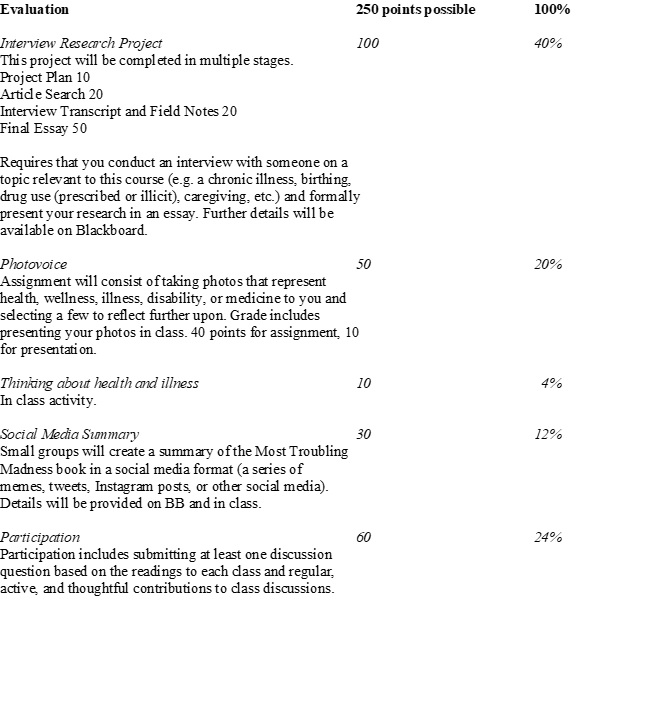
Grading
A reflects meritorious work at a level exceeding expectations
B reflects meritorious work that could use improvement
C reflects work without marked merit that meets basic requirements
D reflects work that falls short of requirements yet warrants credit.
Tentative Course Schedule
Be sure to regularly check Blackboard for updates and additional course materials.
Readings must be completed before class meets.
______________________________________________________________
| Week | Dates | Topic | Readings | Assignments due before scheduled class time day of |
| 1 | 2/7 | Introduction | Syllabus In class activity – Thinking about health and illness | |
| 2/9 | A crash course in Sociology | Julian Go. Race, Empire, and Epistemic Exclusion: Or the Structures of Sociological Thought. | ||
| 2 | 2/14 | Knowledge & Power | Patricia Hill-Collins, Black Feminist Epistemology. | |
| 2/16 | Patricia Hill-Collins, Intersectionality’s definitional dilemmas. | |||
| 3 | 2/21 | Perspectives on health | Shea, Jennifer M., Jennifer Poudrier, Karen Chad, and Jessica Rae Atcheynum. Understanding the Healthy Body from the Perspective of First Nations Girls in the Battlefords Tribal Council Region: A Photovoice Project. | |
| 2/23 | Sharlene Hesse-Biber. The Practice of Feminist In-Depth Interviewing. Namrata Verghese. What is Necropolitics? The Political Calculation of Life and Death. In class time to work on project plan | |||
| 4 | 2/28 | Perspectives on health and illness | Peter Conrad and Kristin K. Barker. The Social Construction of Illness: Key Insights and Policy Implications. | |
| 3/2 | Health care: America vs. the World https://www.youtube.com/watch?v=BytzrjEfyfA Ido Badash et al. Redefining Health: The Evolution of Health Ideas from Antiquity to the Era of Value-Based Care. | |||
| 5 | 3/7 | Healthcare and disability | Leonie Hallo, Alex Gorod, and Susan Merchant. The evolution of healthcare towards patient-centered care and the need for systemic approaches. Watch: Why Finland And Denmark Are Happier Than The U.S. | Final Project plan due |
| 3/9 | Thomas Shakespeare. Disability Rights and Wrongs. In class time to practice interviews | |||
| 6 | 3/14 | Perspectives on disability | Marguerite Scheider, Zitha Mokomane, and Lauren Graham. Social Protection, Chronic Poverty and Disability: Applying an Intersectionality Perspective. Watch: How economic inequality might affect a society’s well-being | |
| 3/16 | Stefanie Kennedy and Melanie J. Newton. The Hauntings of Slavery: Colonialism and the Disabled Body in the Caribbean. | |||
| 7 | 3/21 | Read 2 articles from your article search Present on photovoice assignment. | Photovoice assignment due. Article search for final project due. | |
| 3/23 | Read 1 article from your article search Present on photovoice assignment. | |||
| 8 | 3/28 | Spring Break – No class | ||
| 3/30 | ||||
| 9 | 4/4 | Mental health around the world | T.M. Luhrmann (Editor), Jocelyn Marrow (Editor) Our Most Troubling Madness Intro https://www.youtube.com/watch?v=jQWqBWy8HRE | |
| 4/6 | T.M. Luhrmann (Editor), Jocelyn Marrow (Editor) Our Most Troubling Madness Case Study 1 | |||
| 10 | 4/11 | Mental health around the world | T.M. Luhrmann (Editor), Jocelyn Marrow (Editor) Our Most Troubling Madness Case study 2 | |
| 4/13 | T.M. Luhrmann (Editor), Jocelyn Marrow (Editor) Our Most Troubling Madness Case study 3 & 4 | |||
| 11 | 4/18 | Mental health around the world | T.M. Luhrmann (Editor), Jocelyn Marrow (Editor) Our Most Troubling Madness Case study 5 & 6 | Interview transcript and field notes for final project due. |
| 4/20 | T.M. Luhrmann (Editor), Jocelyn Marrow (Editor) Our Most Troubling Madness Case study 7 | |||
| 12 | 4/25 | Mental health around the world | T.M. Luhrmann (Editor), Jocelyn Marrow (Editor) Our Most Troubling Madness Case study 8 & 9 | |
| 4/27 | T.M. Luhrmann (Editor), Jocelyn Marrow (Editor) Our Most Troubling Madness Case study 10 | |||
| 13 | 5/2 | Mental health around the world | T.M. Luhrmann (Editor), Jocelyn Marrow (Editor) Our Most Troubling Madness Case study 11 Santosh Loganathan and Srinivasa Murthy. Living with schizophrenia in India: Gender perspectives. | |
| 5/4 | T.M. Luhrmann (Editor), Jocelyn Marrow (Editor) Our Most Troubling Madness Case study 12 | |||
| 14 | 5/9 | Mental health around the world | T.M. Luhrmann (Editor), Jocelyn Marrow (Editor) Our Most Troubling Madness Conclusion In class social media summary group assignment. | |
| 5/11 | Where do we go from here? | Mishal Khan et al. Decolonising global health in 2021: A roadmap to move from rhetoric to reform. Monica Mitra Chadhuri et al. Decolonizing global health: Beyond ‘reformative’ roadmaps and towards decolonial thought. | ||
| 15 | 5/16 | CONCLUSIONS | Review | |
| 5/18 | Final project paper due: Essay including interview, articles from your article search, and at least 5 articles from class. | |||
Course Policies
Style & Citations
Submit assignments via BB. If you would prefer to submit paper copies of your work, talk with me. All writing assignments should be saved in a document (Word .docx). Do not submit your assignment as a link to Google docs (links to cloud docs introduce technical challenges with permissions). Save your assignment as a file, and submit the file. Always check to make sure you’ve submitted the correct doc.
Use a common font (Times New Roman, Arial, Calibri), with 11- or 12-point font size. Double space lines with default margins (typically 1 inch). Do not submit your final work with the assignment guidelines included. Make sure to spell check your work. Use in-text citations and include a bibliography page. Use APA or ASA citation style (no need for a cover page).
Late Policy
Try your best to complete work by the deadlines, this will help you to not get behind and feel overwhelmed, it ensures you are prepared for class discussion, and it helps me to be able to grade your work throughout the term (and be able to evaluate where you are at with meeting our learning objectives). However, I will accept late work. Late work within two weeks of the due date will have no penalties, while anything after that will have a 10% penalty. If you are sick, have a death in the family, or have a major disruption that distracts you from your work and you’re going to be later than one week, let me know and late penalties can be waived.
Academic Honesty and Plagiarism
I expect that you are here to learn, and that you want to learn. I understand that there are times that it seems like shortcuts are worth taking, but you will shortchange yourself if you cheat or plagiarize. If you are struggling, please speak with me so that we can make a plan to get you caught up. You are expected to be academically honest. Your assignments in this class must be your original work.
Read the helpful guide at: http://www.writing.utoronto.ca/advice/using-sources/how-not-to-plagiarize to learn to recognize and avoid plagiarism. If you have any questions please ask. Penalties for plagiarized work will be severe. In all aspects of academic honesty, we will adhere to the college policy on academic honesty, as published in the Linfield College Course Catalog.
What is plagiarism?
If you use a direct quote (i.e. someone else’s words), you must include it in quotation marks and cite the source, including author(s) name(s), the date of publication, and the page number. If you summarize or paraphrase an idea from another person, you must cite the source, including author(s) name(s) and the date of publication. Failure to cite your sources, whether intentional or not, is plagiarism. We need to give credit where credit is due! Being able to synthesize your words with the words of others to make an argument, and being able to point to the original author are key skills to develop.
Gadgets and Laptops
I believe that it is up to you to know whether or not you can use your electronic devices as a tool in the class, or if your laptop/tablet/phone will be a distraction. This course is set up to have a lot of course discussion, and requires active engagement. Devices can enhance engagement if you keep electronic notes, or they can be a distraction. If you use a device during class I encourage you all to put your phones and chat communications on “do not disturb” during classes, this way you are not tempted to read and respond to a text message. While it may feel like it’s just a moment for you, it becomes a major distraction not only for you, but for all of those around you. If you have trouble controlling the impulse to engage in text communications or to use your device in ways unrelated to the class, then please keep cell phones, laptop computers, and other devices out of sight, sound, and mind during class sessions.
Absences
Given a significant part of your grade rests on participation, attendance is necessary for that. Dialogue and discussion are an important aspect of learning, so missing it can hinder your education goals. With that said, if you are unwell or have other major responsibilities that become barriers to attendance please let me know as soon as possible so that we can make sure we find good solutions for your situation. If you miss class, you should still complete any readings that are assigned as the readings build on each other. If you have questions, please contact me to clarify. Excessive absences will impact your grade.
Blackboard (AKA BB, BBLearn, BBL)
We will be using Blackboard and you will need to both know how to use it and have a reliable way to access it. If you do not have access through your own computer, you may use one in the library or in one of the several computer labs around campus. You should get in the habit of checking our Blackboard course website most days, if not every day. You will also submit all work via Blackboard and much of that work must be submitted as Word documents. If you don’t have Word, you’ll need to convert your documents into Word on a campus computer.
Resources
Disability Statement
Students with disabilities are protected by the Americans with Disabilities Act and Section 504 of the Rehabilitation Act. If you are a student with a disability and feel you may require academic accommodations please contact Learning Support Services (LSS), as early as possible to request accommodation for your disability. The timeliness of your request will allow LSS to promptly arrange the details of your support. LSS is located in Melrose Hall lower-level room 020 (503-883-2562) and also encourages students to communicate with faculty about their accommodations.
Writing Center
A great resource on campus is the Writing Center in TJ Day Hall 321 and/or the library. Their hours are available on their website at: http://www.linfield.edu/writing-center/
 Wynn Strange